Showing posts with label Foraged. Show all posts

Saturday, 24 September 2016

Wild Elderberry & Chilli Vinegar

Wild Elderberry& Chilli Vinegar


You would have to be a nutter not to make this black beauty...it's fantastic.

© Fig 1. L.Moore Elderberries
This is a spectacular vinegar that goes well with lots of goodies. Any restaurateur should be gagging for this and willing to swap his/her granny for a bottle...a few splashes of this will enrich the dullest dish.  This is a stunning touch of class. It is rich in colour, deep and earthy and makes any meal blush with delight.

I was not expecting this to taste so good but believe me it's worth the effort and time. Since I have made it I have had it on my salad, my burger, my venison sausages, cold meats and cheeses...slurp! Hurry go and bag yourself some elderberries before it's too late. They are so versatile. So far I have made elderberry compote (yum), elderberry cordial (delicious) and now the vinegar. This is an incredible month for foraging I feel like a child in a sweetie shop full of delights. Next time you take a walk have a look for these incredible edibles.

Ingredients

Elderberries 350 g
white wine vinegar 500 ml
Sugar 250 g (add more if you like it very sweet I like mine tarty)
chillies (optional)


All I did was collect my elderberries and weigh them. Then I used a folk to scrape the berries off their branches. You can give them a rinse while still attached under a tap.  If you wash them in a bowl of water then you lose a lot of the juice. If you are worried about little nasties then leave them laid out on newspaper and let the little crawlies have time to leave. The best elderberries to pick are when the branches look droopy and too heavy for the branch...this means they are really full and ripe and hanging heavy on the tree.

OH yes back to the vinegar. Once you have gone through the time consuming bit of plucking your berries off their branches put them in a jar with your chopped chillies. Make sure your jar has enough room to take on 500ml of white wine or cider vinegar. Pour the vinegar over your berries and leave with a lid on for 4 days. After a day or two give them a mash and leave them until day 4. Now sieve them and pour the liquid into a clean pan. Discard the berries or recycle them. Heat up your vinegar and then pour in your sugar and once it dissolves stir for about 10 minutes. Do a taste test and if you want it sweeter add more sugar. Now bottle into sterilized jars or bottles...Ta Dah...you won't be disappointed.  

© Fig 2.L.Moore Elderberry vinegar..yum
© Fig.3. L.Moore What an incredible edible
...there is plenty of sites on the internet that will identify elderberries for you. Once your really sure HAVE A GO...slurp

enjoy xx


Friday, 2 September 2016

Vibrant Sumac, elderberry & blackberry juice

Vibrant Sumac Juice with Elderberries and Blackberries

Whoa...September already...

This is an amazing month/season for fruits , berries and nuts. This is a season for feasting on the goodies of the summer...yum...slurp. We have sumac berries, rowan berries, guelder rose berries, rose-hips, blackberries, plums, hazelnuts (the list is endless)
Fig 1.© L.Moore Vibrant Sumac Juice with blackberries and elderberries 
Now about the Stag horn Sumac. What a great name!

This is a garden escapee that comes from North America. Traditionally the native peoples of North America made a kind of lemonade with it (sometime known as the lemonade tree). The fruits taste of lemon and they are very tarty. You know when a sumac is ready to pick for such a wonderful drink when you touch it. When you press it with your fingers it feels rather sticky. If you lick your fingers you can taste the lemony bitterness of the fruits (be warned it is tarty).

Traditionally the fruits are soaked in water for several hours and then sieved and drank (my recipe uses a slightly different technique). The fruits have fine red hairs that can be dried and rubbed off as a dried herb called sumac. This is a red powder that comes from the dried fruits and it used a lot in Lebanese and Turkish Cuisine. You usually find Stag Horn's Sumac growing on roadsides, railways, embankments, and poor free-draining soils, and gardens. You need to gather the fruits at the beginning of autumn as the winter rain washes away the flavour.

The branch stems are really fuzzy and furry to touch and feel ever so gorgeous. They are supposed to resemble the antlers of a young stag. I have never felt the antlers of a stag but on first experience these velvety red branches feel really soothing. If I close my eyes I can imagine I am touching the antlers of an incerible stag (it's good to imagine...yay).


My Vibrant Sumac Juice with added blackberries and elderberries

5 - 6  sumac cones
sugar (amount depending on the stewed pulp)
Juice of l lemon (optional)
3 handfuls of blackberries
3 elderberry heads
1 liter of water

I placed my furry friends into a pan of water approximately about 1 liter of water and the juice of a lemon (optional). It is best to break up the cones with your hands before you begin to boil your Sumac. Once you have broken them up bring to the boil and simmer for about 10 to 15 minutes adding your elderberries and blackberries for the last 5 minutes. Apparently if you boil the berries a lot the tannin's come out and it tastes quite bitter and strong. Now mash up your fruits and leave to seep in the pan for half an hour (with the heat off). Then strain your pulp through a strainer or cloth and collect the juice into a bowl. Make sure you have the same amount of sugar to juice ratio (i.e the same amount as your extracted juice). Pour your juice back into a clean pan and then add your sugar. Gently heat up until the sugar dissolves and stir for a minute or two. Now it is ready to bottle. I did not sterilize my bottles because I knew I would be drinking it straight away. If you want to store this lovely juice I suggest you sterilize your bottles.

This really is a strange tasting juice (but it is gorgeous). It reminded me a lot of cranberry as it has a little dry after taste. As it is tarty and and dry I recommend tasting it first before you bottle it and decide if it needs more sugar and/or honey.  I had mine with ice and sparkling water added and a sprig of mint...delicious. If this recipe is a little strong for your taste buds try just seeping the berries in boiled water (off the heat) for 15 mins to get a weaker version and add your sugar while it is hot. I added the blackberries and the elderberries to give it a rich vibrant colour and also to reap the benefits of these dark fruits.

© Fig 2.L.Moore Sumac fruit shrub
© Fig.3.L.Moore Sumac juice from the Sumac berries with elderberries & blackberries

© Fig.4.L.Moore Sumac berry with elderberries
© Fig.5. L.Moore Sumac shrub in my neighbors garden

How to recognize the stag horn sumac 

Known as Rhus Typhina.
It is an upright suckering deciduous shrub which stand up to 3 m tall and wide. It has velvety red branches that resemble stags' horns. Large pinnate leaves up to 60 cm long and have 2-31 lance-shaped dark green leaflets that turn bright orange and red in autumn. The yellow/green flowers are produced on upright, conical shoots, up to 20 cm long in mid summer. Followed by female plants of dense clusters which are spherical, hairy and a deep crimson fruit on the tips of the branches (see pics).

Be Careful
Beware of the Rhus Verniciflua which is known as the varnish tree because of it's glossy leaves. It is very toxic and causes painful blisters and aggravates the skin. However this is different because the fruits are YELLOW.  Sumac is crimson red.


'If in doubt leave it out'

What to eat
You can eat the red berries and make a fruit drink. Also you can dry out the fruits and use these as a lemonade substitute (steep in boiled water for an hour or lightly simmer then sieve, pour back into pan adding sugar and simmer for 5 mins until sugar has dissolved). To dry the berries just break them up and keep dark and dry for a few weeks. You can also use the dried berries for jam but make sure you sieve the berries out before bottling the jam.

Once your berries have been dried out rub them through a nylon sieve to remove the red hairs and this is how you get your sumac herb. This is lovely rubbed into chicken as a marinade, added as a topping to hummus and yogurts.Sumac is also on eo f the main ingredients in the spice Za'atar (used in  middle eastern cuisine). Below are some links that may be of interest to health and food and also source material.

Ta da...enjoy this lovely fruit freely

Source material

Fowler, Alys (2011) The Thrifty Forager, pp160-161

http://www.healwithfood.org/health-benefits/sumac-spice-good-for-you.php

http://www.thekitchn.com/inside-the-spice-cabinet-sumac-67042


Thursday, 18 August 2016

Wild cherry plum jam with chilli


Wild Cherry Plum Jam...Yum

Fig.1.L.Moore wild plums and 3 apples with chillies

Fig.2 .L.Moore Wild cherry plum jam/jelly

It's amazing how much free food is about at the moment. I was taking a walk down one of the quiet streets where I live and I came across a load of squashed fruit on the floor. I looked up expecting to see these beauties hanging from some lovely branches. To no avail...there wasn't any. So a bit perplexed I kept on walking . I carry on a little further and there is more of these fruity darlings on the floor...and still no fruit trees as I look up. What's going on? I kept walking and then I saw a little yellow fruit sitting inside a jungle of hedges...hm I thought...maybe someone picked the fruit up and laid it in the tree.

Let me continue with this thought. 

I carry on walking and I see more little yellow fruits sitting in the hedges (the penny has nearly dropped). The fruits are getting more plentiful on the floor. I stand there still thinking about these fruits so I decide to peer a little closer into the urban hedge jungle. I pull back the hedge with my hand and Gordon Bennett (a UK saying)  deep in the jungle are not one but loads of fruit. (yep the penny has finally dropped). There are red, yellow, purple fruits and YES YES and more YES'S it's plum alley. OMG I was in my element. I smell it and take some home for research.

After some reading I eat one...No I'm not ill. They are definitely plums.Well I never! I have not seen these beauties before (I'm not surprised they are so well hidden). So here is my amazing wild cherry fruit jam...it's gorgeous.

Go and scan your local floors by hedges and see if you can fins some...there are loads of them. Of course always be careful 'if in doubt leave it out'.

Recipe
1 and a half pounds of plums (with stones in)
* 3 foraged small apples
half a pint of water
Sugar (the same amount of sieved juice)...read on for this
3 tbs lime or lemon juice
2 hot chillis (depending on your tolerance)

Method
Put your plums in a pan and then add your water. Bring to the boil and simmer until nice and soft. Now mash up your plums so the stones release and you have a soft mash (if it goes a bit dry add some more water. Simmer for a bit more. Then sieve your pulp into a bowl and collect all the juice. You can press it out a bit if you like which may make your jam/jelly cloudy. I pushed my pulp through my sieve a bit and it is not cloudy. 

Once you have collected your juice put it back in the pan. Now pour in your sugar. Your sugar should be the same volume of your juice. I used the same bowl and made a line where the juice came to and poured my sugar into the bowl until it was the same amount of my juice and poured it into my pan. Not chop up your chillies and put them into your pan (including seeds) and then add 3 tbs of lime or lemon juice. I then heated the pan up and brought to the boil. I boiled for about 30 mins to 40 mins stirring continuously. When you feel your wooden spoon resisting the stirring as you stir your jam test it i.e. (take a teaspoon and put on a cold plate and place in the fridge). When it is cold it should crease up when you push your finger into it. If it still too runny then boil a bit more. Then pour into your sterilized jam jars.

* Ooops I forgot to mention the apples. Chop your apples and put them in with your plums in the pan at the beginning (the apples help the jam/jelly set a little).


Hoorah...it's gorgeous.

This can be used with yogurt and fruit, or on toast with butter, or with cold meats and cheeses and also put into a stir fry. Experiment...I have tons more so I will be getting creative with these plums so watch this space. 

Fig.3. L Moore Can you see them?
Fig.4. L. Moore Can you see them now?
Fig.5. L.Moore Arh there they are
Fig 6. .L.Moore Now you see them
GO AND GET SOME... enjoy


Monday, 30 May 2016

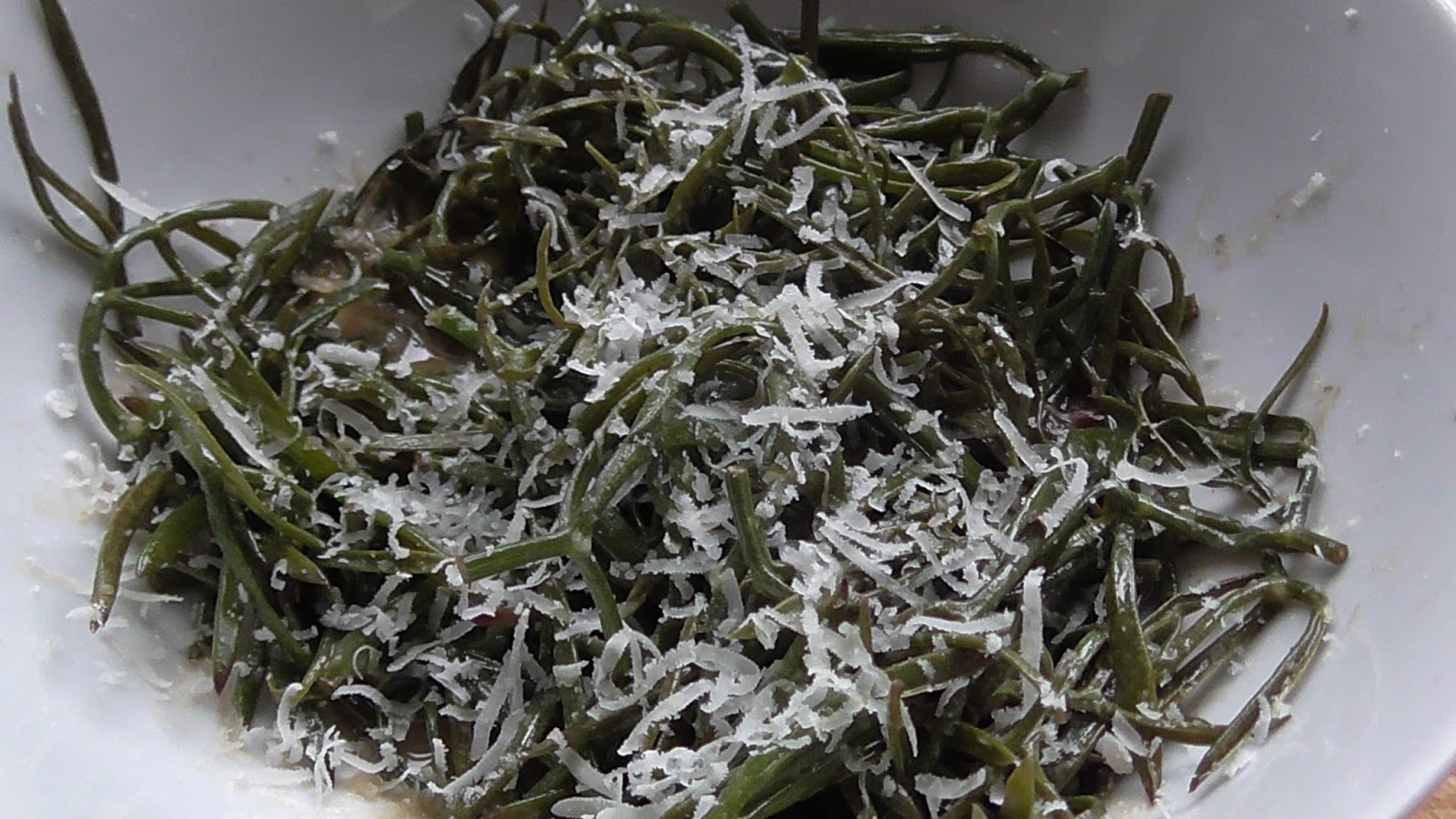
Lemon Rock Samphire with parmesan cheese

Lemon Rock Samphire with Parmesan Cheese


Well what can I say about this crazy abundant edible?

It's Absolutely marvelous


© L.Moore Fig 1. Lemon Rock Samphire with Parmesan
© L.Moore. Fig.2 Rock Samphire Just collected from rock face
© L.Moore. Fig.3. Rock Samphire on cliff face
© L.Moore. Fig.4. Rock Samphire in context on rock face
© L.Moore. Fig 5. Lemon Rock Samphire with Cheese
© L.Moore. Fig 6. Empty dish speaks volumes (my first trial of samphire cooked on holiday) 
© L.Moore fig. 7. At home with salmon
I went on a family holiday to Devon and found this extraordinary edible on the cliff face within easy reach of little old me. This was a very lucky find because usually rock samphire can be incredibly difficult to get on a cliff face. As soon as I saw it I knew immediately what it was. I bagged a handful and went back to our holiday house and did my research on it. It was indeed rock samphire. I had never tasted rock samphire before. I had tasted marsh samphire from certain supermarkets but I have never seen this wonder. I tried it raw first (when I was 100% certain what it was) as a little nibble and thought 'wow that's different'. I can't find the words to explain how it tastes but my interpretation of it reminds me of a celeriac. NO one else agrees with me of course so don't take my opinion literally. You will have to try it yourself. A lot of recipes suggest pickling it and I can see why. I imagine it would pickle really well. So as per usual I wanted to experiment with it...and hey presto here is my little recipe which I thought was yummy.  


4 big handfuls of rock samphire
4 cloves of garlic
2 tbs butter (or oil of your choice i.e coconut etc.)
1 lemon
2 tbs cream cheese (optional)
Parmesan for grating on top

In a pan steam your rock samphire for about 10 minutes and drain off as much water as you can. Then in a frying pan add your butter and lightly fry your garlic and then add your samphire and the juice of half to a full lemon. Fry for about 5 minutes and then add your cream cheese and stir in. Put your samphire in a warm ovenproof dish and then grate your parmesan cheese on top. Place under the grill for a few minutes and serve. I had mine with salmon and mint potatotoes and I have also had it in a warm salad with chicken and with pasta. Experiment with your adorable find. I can assure you it quite an extraordinary taste that will tickle those taste-buds..delicious.

I was lucky enough to bring some home and I put in the fridge for a week and it was still amazing. My partner delighted me by making me a chicken ballotine wrapped in garden herbs and parmesan cheese served with lemon samphire (without the cheese and steaming ...he fried it in garlic butter and lemon juice yum yum). Ah this is the life eating and exploring new edibles...what more does a woman want. If you have tried it and come up with innovate ways of using it then please let me know I would love to hear from you.

As usual please gather responsibly. I only take what I need and I always pick from a number of plants to ensure the plant thrives. Again 'if in doubt then leave it out'. I claim no responsibility for your identification of your wild foods. Be sure to try a tiny amount to see if it agrees with you. Below are some useful sites to help you identify rock samphire, recipes and other useful information.

http://www.recipes4us.co.uk/Rock_Samphire.htm
http://www.gallowaywildfoods.com/rock-samphire-identification-edibility-distribution/


Thursday, 24 March 2016

Dulse pesto

Dulse Pesto


L.Moore. Fig 1. Dulse pesto
Where has March gone?

The day's have flown and here we are  at the latter end of the month and Easter is upon us. Let's celebrate spring. Such an exciting season full of edible wonders. I have not had chance to forage much so far this month. However I do pluck some amazing chickweed, hairy bittercress and wood sorrel on my way to the local shop and make a yummy salad with it. At least three time this month I have chomped on this lovely salad with this amazing seashore pesto and courgette ribbons...a winner every time. I am so excited about Spring and I can't wait to bag me a load of wild garlic...it is to die for. In fact I am going away for the Easter weekend (glamping) LOL. This is all new to me but I am sooooo looking forward to it. It will be out in the country among a wild wood and streams so I can hopefully anticipate some fantastic edibles.

Me and my partner went to Cornwall in December last year because we heard the fish is so fresh you are eating it not long after it has been caught. Yes we are right foodies so we will travel a fair distance to tantalize our taste buds. We stayed in a beach residence really close to the beach. From our window we coukld see the tide coming in and out with a truly superb moonlit sky.  I managed to drag my partner out of bed in the morning to scour the rocks, sands and shallow waters for seaweed. We came bag with a bucket load which is now hanging up in my back room all dried out. I can use it anytime in a variety of wonderful ways. Dulse is the red seaweed and it is so versatile. I crush it up and add it to my rock salt in my recipies. I also use it in my broths, stews and casseroles. But recently I made this Dulse wonder and overdosed on it for three consecutive days.

Fig. 2. L.Moore Dulse pesto with Basil & Parmesan Cheese

Fig.3. L.Moore, as above

Fig.4.L.Moore, as above

Fig.5.L.Moore, Dulse pesto

Fig.6. L.Moore Dulse Pesto

Fig.7.L.Moore Dulse Pesto on crackers 

Dulse Pesto

In a bowl add the following ingredients and mix together with a hand blender. Add the grated Parmesan cheese last and stir it in with a spoon. You can change the consistency by adding more oil, more cheese etc.
To hydrate your dried Dulse put it in a heatproof  bowl (or cup) and add boiling water and stand for 15 minutes. Then add to your ingredients. You can experiment with these ingredients perhaps replacing the pine nuts with other nuts or herbs.

I tried this on crackers with some goats cheese and it was delicious. I also used it in a stir fry with my courgette  ribbons. I made my ribbons. I then Fried garlic with coconut oil and added my pesto. Then I added some Kale and stirred for a few minutes. Then I added my ribbons for a minute and squeezed some lemon through my stir fry. I plated up and added some grated parmesan. Boy it was delicious. I should have taken a photograph.  

25g pine nuts
4-5 cloves of garlic
15g basil
15g parsley
50g of hydrated dulse seaweed
10tbs of good quality olive oil
1 tsp of dried chilli flakes
2 tbs lime juice
a handful of grated parmesan cheese
salt and pepper to taste

Identifying Dulse also known as Dillisk

Dulse is a dark reddish brown. It has leathery thin, flat fronds that are divided into lobes about 30mm wide and up to 1m long.You can find Dulse on the beach around the British Isles but absent from the less rocky coasts of Eastern England. It resides above and below the low tidemark, on rocks but also on the stripes of the cuvie Laminaria hyperborea. I live in south eastern england and I am a fair distance from any coasline. I got my Dulse in Cornwall during December last year while I was away for the weekend. I bagged quite a lot to last me until my next coastal visit. Other red seaweeds such as Carrageen is usually found in toothpaste, ice cream, milkshakes, and processed foods due to it's gelatinous quality that functions as a thickener, stabilizer, and setting agent. Dulse is also fab for drying out. I hang mine up in the shower to dry off...a bit of a shock for any visitor LOL. It is also great to grind and/or use as flakes and add it to your salt.

So next time your at the beach have a scour for Dulse you will be surprised what you find. Us Brits don't make the most of our coastlines. Our coastlines are a haven for the sea forager. The nurtional benefits of Dulse is amazing. I have included a link so you can have a look at the nutritional benefits of Dulse. It has a lot of Iodine & Potassium and vitamin E, IU, Vitamin A, IU, Vitamin B1 ,B2 ,B6, B12 mg and vitamin C.

Fig 8. L.Moore Dulse soaking in my sink 
Fig.9.L.Moore More Dulse in my sink

Source material
 Irving, M. (2009) The Foragers Handbook: A Guide To The Edible Plants Of Britain ,Ebury Press,  pp.369-370
https://www.seaveg.com/shop/index.php?main_page=page&id=15&chapter=5


Wednesday, 23 March 2016

Dulse & Jelly Ear Broth

Dulse & Jelly Ear Broth

This is a winner and very much like a miso soup broth. I am a bit late with this post as it was written in early January but I thought it was good to share. When I came across this fungus I was really surprised. I was out looking for some edible greens when I happened upon these by mistake. There they were clutched to an elder tree like like little bats hanging upside down. They feel really jelly like (hence their name) and their life span is short. I went back a week or so later and they had died off. I was disappointed I never collected more of these earthy gems. They dry out great and can be stored away for ages. When they dry out they reduce to almost 80% of their original size. When you re-hydrate them it's almost miraculous...they slowly grow...they are amazing. The combination of this fungus with dried dulse seaweed is beautiful and packs a vitamin punch.

L.Moore. Fig 1. Jelly ears on elder tree   
L.Moore Fig 2. Dulse & Jelly Ear Broth
L.Moore.Fig 3 Dulse & Jelly Ear Broth with homemade bread
L.Moore.Fig 4. Close up of Jelly Ears
L.Moore. Fig 5. Dried Dulse seaweed 
L.Moore. Fig. 6. Fresh Jelly Ears

Dulse Seaweed & Jelly Ear Broth

1 litre of vegetable stock
half a broccoli
1 carrot
a handful of kale
a dried chilli (optional)
handful of dried dulse
4-5 jelly ears rehydrated (or fresh)
2 cloves of garlic

Place your dried jelly ears in a small heatproof bowl and pour boiling water on top. Leave for 10 minutes. In a pan add your 1 liter of vegetable stock, chilli (optional) and your jelly ears (including the juice from the re-hydration) and simmer for half an hour. Then cut up your dried dulse into small strips (with scissors) and add grated garlic and add to the pan with your finely chopped carrot (cut into small strips) and simmer for 10 minutes. Lastly add your broccoli for 5 minutes and simmer. Pour into bowls and enjoy with some home made bread Ta Dah!

This fungus is also known as 'Jews ear' relating to the story of Judas hanging himself from an Elder tree. However I prefer to call them jelly ears. There is a lot of interesting  information about this strange fungus in folklore and pharmacology. Apparently this fungus may have anti-tumor benefits, it may lower cholesterol and act as a coagulant.   

this may be interesting to read

https://en.wikipedia.org/wiki/Auricularia_auricula-judae