Showing posts with label Antispasmodic. Show all posts

Thursday, 18 August 2016

Wild cherry plum jam with chilli


Wild Cherry Plum Jam...Yum

Fig.1.L.Moore wild plums and 3 apples with chillies

Fig.2 .L.Moore Wild cherry plum jam/jelly

It's amazing how much free food is about at the moment. I was taking a walk down one of the quiet streets where I live and I came across a load of squashed fruit on the floor. I looked up expecting to see these beauties hanging from some lovely branches. To no avail...there wasn't any. So a bit perplexed I kept on walking . I carry on a little further and there is more of these fruity darlings on the floor...and still no fruit trees as I look up. What's going on? I kept walking and then I saw a little yellow fruit sitting inside a jungle of hedges...hm I thought...maybe someone picked the fruit up and laid it in the tree.

Let me continue with this thought. 

I carry on walking and I see more little yellow fruits sitting in the hedges (the penny has nearly dropped). The fruits are getting more plentiful on the floor. I stand there still thinking about these fruits so I decide to peer a little closer into the urban hedge jungle. I pull back the hedge with my hand and Gordon Bennett (a UK saying)  deep in the jungle are not one but loads of fruit. (yep the penny has finally dropped). There are red, yellow, purple fruits and YES YES and more YES'S it's plum alley. OMG I was in my element. I smell it and take some home for research.

After some reading I eat one...No I'm not ill. They are definitely plums.Well I never! I have not seen these beauties before (I'm not surprised they are so well hidden). So here is my amazing wild cherry fruit jam...it's gorgeous.

Go and scan your local floors by hedges and see if you can fins some...there are loads of them. Of course always be careful 'if in doubt leave it out'.

Recipe
1 and a half pounds of plums (with stones in)
* 3 foraged small apples
half a pint of water
Sugar (the same amount of sieved juice)...read on for this
3 tbs lime or lemon juice
2 hot chillis (depending on your tolerance)

Method
Put your plums in a pan and then add your water. Bring to the boil and simmer until nice and soft. Now mash up your plums so the stones release and you have a soft mash (if it goes a bit dry add some more water. Simmer for a bit more. Then sieve your pulp into a bowl and collect all the juice. You can press it out a bit if you like which may make your jam/jelly cloudy. I pushed my pulp through my sieve a bit and it is not cloudy. 

Once you have collected your juice put it back in the pan. Now pour in your sugar. Your sugar should be the same volume of your juice. I used the same bowl and made a line where the juice came to and poured my sugar into the bowl until it was the same amount of my juice and poured it into my pan. Not chop up your chillies and put them into your pan (including seeds) and then add 3 tbs of lime or lemon juice. I then heated the pan up and brought to the boil. I boiled for about 30 mins to 40 mins stirring continuously. When you feel your wooden spoon resisting the stirring as you stir your jam test it i.e. (take a teaspoon and put on a cold plate and place in the fridge). When it is cold it should crease up when you push your finger into it. If it still too runny then boil a bit more. Then pour into your sterilized jam jars.

* Ooops I forgot to mention the apples. Chop your apples and put them in with your plums in the pan at the beginning (the apples help the jam/jelly set a little).


Hoorah...it's gorgeous.

This can be used with yogurt and fruit, or on toast with butter, or with cold meats and cheeses and also put into a stir fry. Experiment...I have tons more so I will be getting creative with these plums so watch this space. 

Fig.3. L Moore Can you see them?
Fig.4. L. Moore Can you see them now?
Fig.5. L.Moore Arh there they are
Fig 6. .L.Moore Now you see them
GO AND GET SOME... enjoy


Thursday, 21 July 2016

Rich Mahonia Syrup

Rich Mahonia Syrup

Not only does this look good IT IS GOOD!


© Fig 1.L.Moore. Rich Mahonia Syrup with yogurt and fresh fruit

What can I say? When I first came across these dark rich tiny black beauties I thought 'woah...I bet they are dangerous'. I'm guessing there are millions who also thought the same. Good news my friend these little gems are indeed edible. Don't get me wrong they pack a seriously bitter punch to your tongue but they are worth the effort. Because of their bitterness they are understood as a 'bitter' which is, I believe, very good for the liver as it help the body secret fluids through triggering the bile ducts so no wonder it's used as a detox for the body.

This Oregon Grape known as Mahonia aquifolium is found throughout England in hedges, woods, gardens, parks and other public places. I came across these a few gardens down from where I live. I was walking by the said house while the occupants were doing a bit of gardening. I asked them what the plant was called and ran home and did my research. I ran back the next day and pleaded for some of their berries. There was a look of bewilderment because the owners of the plant had always assumed the berries were poisonous. 'Nope I said with pride...they are definitely edible'. I explained how bitter the are and how sugar is a must for cooking. I was up against the clock because the birds had had a field day on them over the past 24 hours.  

I had anticipated a few jars of jelly or jam but the birds beat me to it...the beloved plant was near bald when I got there. I know...I know...there is plenty for everyone and we all need to share with our little feathered friends. What is fab is now I know them I see them everywhere. The berries are about from June onwards. Right now though I can't find a shrub with any fruits on so you need to be quick.

Anyway here is my amazing Rich Mahonia Syrup made from the ripe fruits.

Rich Mahonia Syrup
A bowl of fruits
about half a pound of sugar (taste as you go)
squeeze of a little lemon juice
Cover your berries with about 2 mugs of water (just covering)
Potato masher

Method

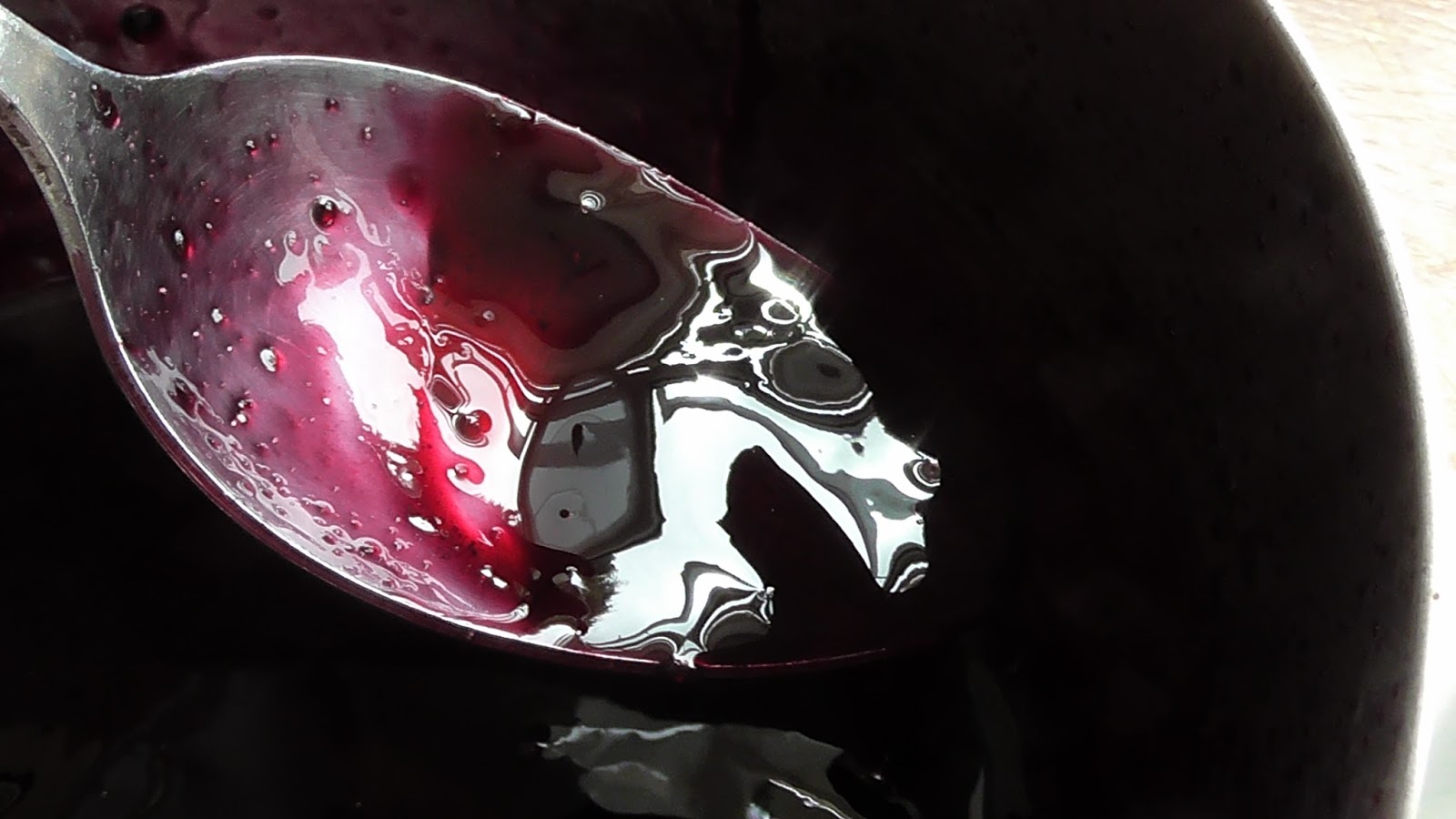
I washed my berries in cold water and placed them in a pan. Cover the fruits with about 2 mugs of water. Bring to the boil and simmer for about 10-15 mins until your water runs a rich purple. While it is simmering use your masher and mash up the berries to extract more juices. Now add your sugar (try adding a bit at a time until it is sweet enough) and keep stirring until the sugar dissolves. It should be quite sweet because you will only use a little at a time. If needed add a little more water so it is not too thick. Once you have added your sugar simmer for a further 5 or 10 mins but keep an eye on it so it does go like toffee. You want your mixture just very slightly thick while it is hot because when it cools down it will go thicker. If your not sure turn the heat off and wait until it cools to check the consistency of your syrup. If you cool it down this way you can always make it thicker by adding more sugar and warming it up again but the reverse is not possible. If it is too thick while it is hot it will cool down like toffee (who knows it may come in handy) so watch it well. When it cools down pour into a jar and place in the fridge and use when you need it.

This syrup is very diverse. I have used mine with yogurt and fresh fruit...yummy. Also it can be used with ice cream and cereals and/or your granola, added to stir fries and gravies...delicious. You could even add hot water to it and make it into a nice hot drink or you could cool your drink down and add some soda water to make a refreshing drink with some mint...Ta Dah.


© Fig 2.L.Moore The Oregon Grape Shrub 
© Fig.3.L.Moore Oregon Grape close up
© Fig 4.L.Moore Oregon Grape to scale with a coin 
© Fig 5.L.Moore. Syrup with yogurt and fruit
© Fig 6.L.Moore. Making Syrup in Pan
© Fig 7.L.Moore. Lovely glossy syrup
© Fig. 8. L.Moore Pouring syrup on fruit & yogurt...yum
This shrub is so versatile the leaves, the bark and roots are also used medicinally for a number of ailments. Berberine is a chemical constituent found in several different plants and it is one of the main ingredients that attracts herbalists to this shrub. There have been many claims that the Oregon Grape Root is good for including: lowering blood sugar levels, fights infections, skin infections, drains and detoxifies, an anti spasmodic, and other claims are the impact it has on the liver because it is understood to be a hepatic (herb for the liver). The berries are also packed with vitamin C.

Remember to forage responsibly and always be extra careful that you know 100% what it is you are about to eat. Check with friends and do your research and only try in small quantities first  "if in doubt leave it out". Check a variety of sources and do not always rely on the internet as a source of truth...make your own mind up. There will be other fruits about that are dangerous look a likes.

IN saying that don't be discouraged go and forage with a group of friends and enjoy the wonders of a new window to the world. Start with safe options like dandelions if your totally new to foraging...it's amazing.

Enjoy!

Description
A small evergreen shrub with dark green, spiny holly-like leaves and bright yellow flowers in dense clusters, which later produce blue fruit in clusters resembling bunches of small grapes. Flowers January-May; fruit ripe June onwards.

Disclaimer
The information in this post is not my expert opinion on herbal medicinal remedies and/or health claims. Everything I say about this plants medicinal properties are taken from a number of sources which you can access below.

Source material

Irving, Miles (2009) The Forager Handbook:A guide To The Edible Plants Of Britain, Ebury Press, p50.
http://www.herbalremediesadvice.org/oregon-grape-herb.html
http://www.peoplespharmacy.com/2005/10/18/oregon-grape/


Friday, 5 February 2016

Guelder Rose Cramp Bark Decoction


Guelder rose Cramp Bark Concoction (viburnum opulus)


L.Moore.Fig 3. Cramp Bark Decoction 

L.Moore. Fig 1&2 dried bark crushed & put in a jar


This is a wonderful drink. It is a bright red soothing drink and it is taken from the bark of the Guelder rose tree. Most books suggest taking the bark in April/May but I have been taking mine in Jan/Feb and it is truly wonderful. I can't tell you how incredible this tree is. It has the most outstanding scarlet berries in late summer and wonderful flowers in the spring and of course the tree bark. All of these can be used in all sorts of delicious exciting ways which I will introduce in new posts (i.e jellies, cordials, jams etc.). What is extraordinary about the bark is the many medicinal qualities it offers the body. The bark has been used as an anti-spasmodic, a sedative and an astringent.

Cramp Bark has a reputation as a relaxer of muscular tension and spasm and it has two main areas of use. 'Firstly in muscular cramps and secondly in ovarian and uterine muscle problems'. (Hoffman 1990, p 194).  According to David Hoffman, in his book Holistic Herbal: a safe and Practical Guide to Making and Using Herbal Remedies (1990) Cramp Bark will relax the uterus and so relieve painful cramps associated with periods (dysmenorrhoea). It may also be used 'to protect from threatened miscarriage. Its astringent action gives it a role in the treatment of excessive blood loss in periods and especially bleeding associated with the menopause.' I have also read it  has been used for arthritis, muscle tension in skeletal muscles, back pain, fibromyalgia, irritable bowel syndrome and high blood pressure. In the book Hedgerow Medicine Harvest and Make Your Own Herbal Remedies (2008) Julie Bruton-Seal  & Mathew Seal cramp bark helps in rheumatic conditions where the pain is from tension rather than inflammation, easing the pain and improving blood flow to the affected area.    

Reference
Bruton-Seal, J&M. (2008) Hedgerow Medicine:Harvest and Make Your Own Herbal Remedies, Merlin Unwin Books, (p. 62).
Hoffman, D. (1990) Holistic Herbal: A safe and Practical Guide to Making and Using Herbal Remedies, Harper Collins Publishers, (p. 194)

Cramp Bark Decoction

Method
Use a small knife to remove the bark in short strips, taking care not to take too much from any branch. Do not ring the limb or it will die. The bark can be used dried or fresh. I dried mine out on a clean sheet of paper in my kitchen which took about four days. The bark begins to dry with a lovely orange tinge to it. When it dried out I placed it in a plastic bag and bashed it with a rolling pin to break it up into tiny pieces and placed them in a dry glass jar.

Making your decoction
Put about 1-2 tablespoons of bark in a pan and cover with water (enough for about a large cup of tea). Bring to the boil and then simmer for about 10-15 minutes. You will notice the water turn  a lovely red/orange color. Turn off the heat and sieve into a glass or cup and drink with honey if desired. It is an acquired taste but not unpleasant. You can take this twice a day if needed.

I have had this many times and I really find it soothing on the stomach. I read somewhere it acts like an aspirin on the stomach. I am not sure if you are allergic to aspirin whether it would affect you so I would probably stay away from cramp bark.  It is always best to be safe. However I find it a good relaxant for the stomach. Below are two images of the Guelder rose tree taken in October 2015 with the berries on. I took my bark in January 2016.

L.Moore Fig.4. Guelder Rose Tree taken in Oct
L.Moore Fig. 5. Berries on the tree (Oct 2015)