Showing posts with label Raw. Show all posts

Monday, 15 February 2016

Goosegrass/sticky-willy Pesto

                                                 Goosegrass/sticky-willy pesto


Fig.1. L. Moore Goosegrass Pesto

Who would have thought that green stuff that sticks to your clothes like Velcro could be amazing for the body and above all free and edible. Well it's about right now in our towns and cities, gardens, waste-ground etc... it's young and at it's best so get plucking. This plant is also known as 'sticky-willy', 'cleavers' and 'scratch tongue' (I know it doesn't sound great but believe me it's not bad at all). The young shoots can be used in salads and all of the plant can be used in soups, ointments for the skin and juicing. Eat the stems while young before the plant sets seed and become tough. There is no time like the present so give it a go. Let's go and get some 'sticky-willy' and be creative. If your bored and need a reason to get out and about then 'go-seek and find' ... YaY.

Honestly there is nothing better than finding a free edible and rushing home and experimenting with it. I came home with a small bag of the stuff and made this lovely pesto ...Ta Dah. Then my entire meal was designed around my new creation. As it was pancake Tuesday this week my partner and I went overboard with making pancake mix and we have had pancakes all week. Needless to say I had my pesto spread onto a pancake with oven baked chicken breast and lashings of cheddar cheese ...oh yes it was yummy. Terrible for the midriff but hey ho it's only once a year (the pancakes that is). I can think of many ways of using this pesto with the obvious pasta, on toast with a variety of toppings, adding it to risottos and perhaps toppings for soup with a bit of cream. mmmm... My only criticism of my recipe was I put too much salt in it so I had to use it sparingly. But we all live and learn and I'll know better next time.

Goosegrass/sticky-willy Pesto

4 cups of goosegrass (or half carrier bag)
4 cloves of garlic
1 tbs pine nuts
3 tbs grated Parmesan cheese
1 tsp lime juice
salt to taste
add olive oil as you mix ingredients

Wash your goosegrass in the sink with a little salt to get rid of any bugs and/or dog bacteria. Pat the goosegrass dry and place in a bowl or blender. Add the remaining ingredients and blend all together. Add the olive oil  bit by bit until it is the right consistency and enjoy. You need quite a lot of goosegrass. The image I have put on this blog is half a jar made from 3 cupful's of goosegrass. As with all my recipes experiment and explore with your new wild edibles and have fun. Also if you are unsure about what you have picked remember 'if in doubt then leave it out'. Be certain of what you have.

Fig.2. L.Moore Goosegrass/sticky-willy pesto

Fig.3. L. Moore goosegrass growing down a path

Fig.4. L. Moore A close up of goosegrass


According to the book Hedgerow Medicine, Harvest and Make Your Own Herbal Remedies, by Julie Bruton & Mathew Seal (2008) cleavers (goosegrass) 'promotes the lymphatic flow and helps rid the lymphatic system of metabolic waste. In effect, it is like a pipe cleaner for our lymph vessels' (2008, p.31). Cleavers are understood as a useful remedy for swollen glands, tonsillitis, and adenoid problems and earache. Because of it's effect on the lymph system cleavers enjoy a reputation for helping to shrink tumors, both benign and cancerous, and for removing nodular growths on the skin. Other benefits include promoting the flow of urine and soothes irritation of the urinary tract. It relives the scalding pain on urination associated with cystitis and used as a remedy for kidney inflammation and irritable bladder. It is also effective in clearing grit, gravel or calcium deposits in the urinary tract.    

Description
'Very common native annual. Stems are made sticky by downwardly curved prickles. Leaves, in whorls of 6-8, are up to 50 mm long, pale green and thin, with sticky, prickly edges. Young shoots grow upright; the layers of whorls quite geometric and ordered but they sprawl out as they grow, eventually forming a thick, tangled mess. Tiny greenish white flowers grow in loose clusters from the axil of the upper leaves; the fruits are the familiar sticky burs.'. This text is taken from the forager handbook by Miles Irving, (2009)  p 51-52 A similar species is the 'Sweet Woodruff' which has smooth stems and leaves and white flowers (also edible).

References/useful resources
Bruton-Seal, J & M. (2008) Hedgerow Medicine, Harvest and Make Your Own Herbal Remedies, Merlin Unwin Books, pp 30-33
Irving, M. (2009) The Forager Handbook: A Guide To The Edible Plants Of Britain, Ebury Publishing, pp 50-51
http://www.herbalextractsplus.com/goose-grass.html
http://www.woodlands.co.uk/blog/woodland-flowers/white-flowers/bedstraws-and-cleavers/


Friday, 5 February 2016

Guelder Rose Cramp Bark Decoction


Guelder rose Cramp Bark Concoction (viburnum opulus)


L.Moore.Fig 3. Cramp Bark Decoction 

L.Moore. Fig 1&2 dried bark crushed & put in a jar


This is a wonderful drink. It is a bright red soothing drink and it is taken from the bark of the Guelder rose tree. Most books suggest taking the bark in April/May but I have been taking mine in Jan/Feb and it is truly wonderful. I can't tell you how incredible this tree is. It has the most outstanding scarlet berries in late summer and wonderful flowers in the spring and of course the tree bark. All of these can be used in all sorts of delicious exciting ways which I will introduce in new posts (i.e jellies, cordials, jams etc.). What is extraordinary about the bark is the many medicinal qualities it offers the body. The bark has been used as an anti-spasmodic, a sedative and an astringent.

Cramp Bark has a reputation as a relaxer of muscular tension and spasm and it has two main areas of use. 'Firstly in muscular cramps and secondly in ovarian and uterine muscle problems'. (Hoffman 1990, p 194).  According to David Hoffman, in his book Holistic Herbal: a safe and Practical Guide to Making and Using Herbal Remedies (1990) Cramp Bark will relax the uterus and so relieve painful cramps associated with periods (dysmenorrhoea). It may also be used 'to protect from threatened miscarriage. Its astringent action gives it a role in the treatment of excessive blood loss in periods and especially bleeding associated with the menopause.' I have also read it  has been used for arthritis, muscle tension in skeletal muscles, back pain, fibromyalgia, irritable bowel syndrome and high blood pressure. In the book Hedgerow Medicine Harvest and Make Your Own Herbal Remedies (2008) Julie Bruton-Seal  & Mathew Seal cramp bark helps in rheumatic conditions where the pain is from tension rather than inflammation, easing the pain and improving blood flow to the affected area.    

Reference
Bruton-Seal, J&M. (2008) Hedgerow Medicine:Harvest and Make Your Own Herbal Remedies, Merlin Unwin Books, (p. 62).
Hoffman, D. (1990) Holistic Herbal: A safe and Practical Guide to Making and Using Herbal Remedies, Harper Collins Publishers, (p. 194)

Cramp Bark Decoction

Method
Use a small knife to remove the bark in short strips, taking care not to take too much from any branch. Do not ring the limb or it will die. The bark can be used dried or fresh. I dried mine out on a clean sheet of paper in my kitchen which took about four days. The bark begins to dry with a lovely orange tinge to it. When it dried out I placed it in a plastic bag and bashed it with a rolling pin to break it up into tiny pieces and placed them in a dry glass jar.

Making your decoction
Put about 1-2 tablespoons of bark in a pan and cover with water (enough for about a large cup of tea). Bring to the boil and then simmer for about 10-15 minutes. You will notice the water turn  a lovely red/orange color. Turn off the heat and sieve into a glass or cup and drink with honey if desired. It is an acquired taste but not unpleasant. You can take this twice a day if needed.

I have had this many times and I really find it soothing on the stomach. I read somewhere it acts like an aspirin on the stomach. I am not sure if you are allergic to aspirin whether it would affect you so I would probably stay away from cramp bark.  It is always best to be safe. However I find it a good relaxant for the stomach. Below are two images of the Guelder rose tree taken in October 2015 with the berries on. I took my bark in January 2016.

L.Moore Fig.4. Guelder Rose Tree taken in Oct
L.Moore Fig. 5. Berries on the tree (Oct 2015)


Thursday, 4 February 2016

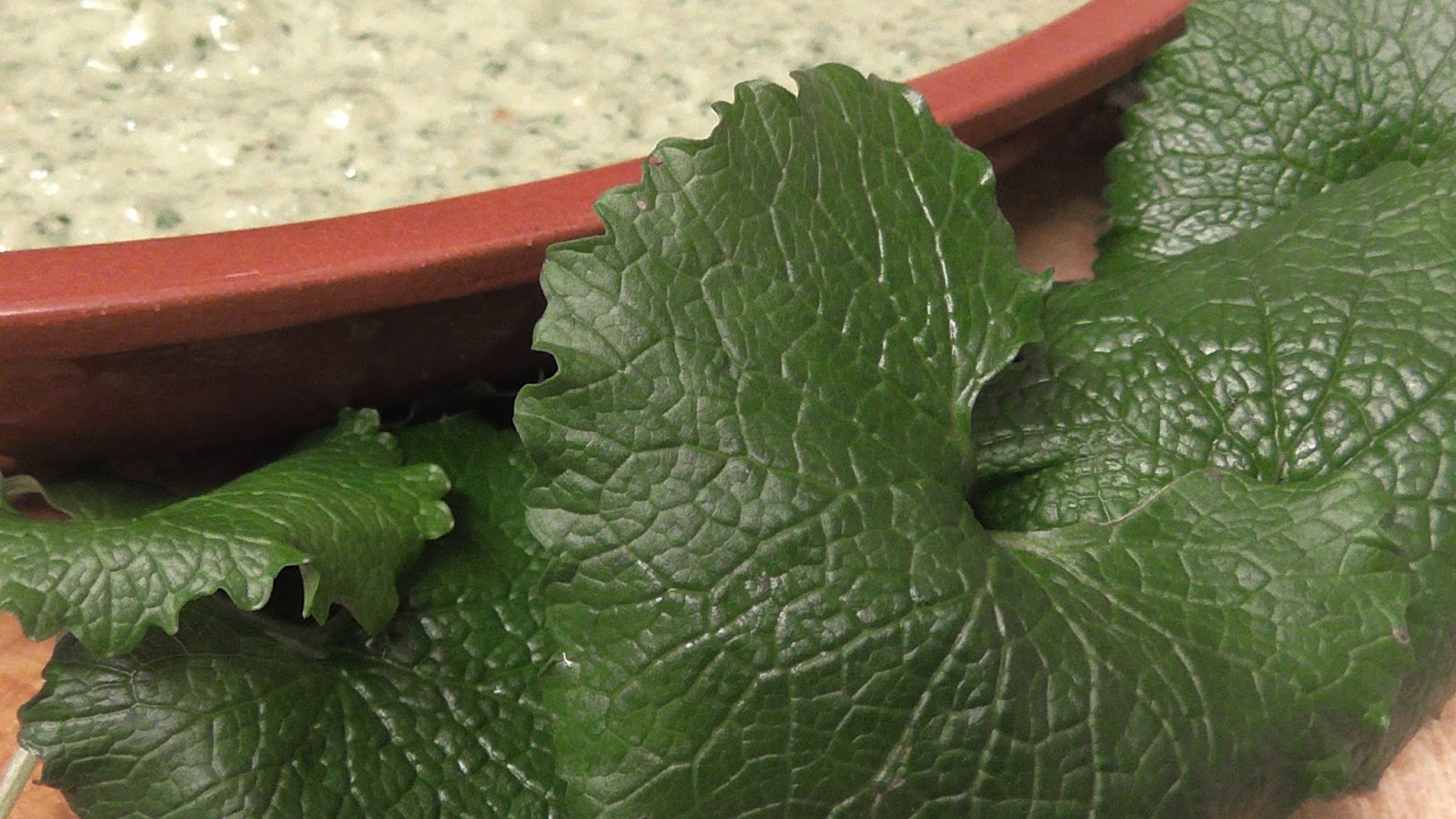
Jack (garlic mustard) Salsa Verde

Jack Salsa Verde

Oh my goodness this is to die for... it is much lighter than my 'nettle verde' (see other posts). This truly is a taste sensation and I had it with my homemade bread and my scrumptious nettle soup. What is most amazing about this little gem of a dip is the fact one cannot buy it in the supermarket and I feel rather pleased with myself. Whenever I come across jack-by-the-hedge or it's other name (garlic mustard) I can't resit picking it. I pick a little from each patch and gather in different locations to keep it going and leave plenty for other gatherers. There is nothing quite like picking your own food and experimenting with it.

All my recipes are intended to be exploratory. I document my experience as a forager and like to share what I can do with these wonderful wild edibles. I always know when a experiment is successful because the food is scooped up immediately and I have my partner and friends to thank for that and their wonderful honest comments. I will continue adding 'Jack' to my food creations so keep an eye out for new taste sensations.

I made my 'Nettle & Jack Salsa Verde' a few weeks ago and it was very powerful indeed. It packed a punch with it's taste and the colour was truly amazing. From that 'Jack Verde' was born ... and boy am I glad I made this ... I love it. Here is the recipe and I hope you enjoy it as much as I do. Spread it all over a homemade bread, have it with cheese or plonk it on top of a good fish ... the list is endless ... just try it ... yum!


Fig. 1. L. Moore 'Jack Salsa Verde' 

Fig .2. L.Moore A Detail of 'Jack Salsa Verde' 

Fig.3. L.Moore 'Jack Verde' with my homemade tomato bread
Jack Salsa Verde

1 decent sized bowl of jack-by-the-hedge
2 handfuls of pine nuts
2 anchovies
1 large tbs mascapone
4 good sized cloves of garlic
1 handful of capers
1-2 tbs lime juice
A good glug of olive oil
Salt & black pepper

Wash your jack in a bowl of tepid water. I add a little salt (to get rid of any nasties) and give it a good wash and then sieve and rinse under the tap to get rid of the salt. Add your jack and all the other ingredients into a bowl and wiz up with a hand blender (or put them all in a blender) until it is a nice consistency. Ta Dah it's done. Spoon it into a nice dish and eat ... Yummy.  Oh for decoration add a touch of olive oil on the top and a few Jack leaves.

This recipe can be altered in any way you wish. If you like it a little thinner add more oil etc and less mascapone ... just explore and enjoy.


Nettle & Jack (garlic mustard) Salsa Verde

Nettle & Jack (garlic mustard) Salsa Verde

Wow what a way to use your fresh foraged wild green weeds than to make a salsa verde. This certainly does live up to it's name (green sauce). This is packed with a punch of vitamins. When I was eating this I felt like I was taken back in time during my ancestral period but without the trimmings. The colour takes your breath away ... it is very dense and moss like. "Stinging nettles are one of the best plants for human health, both as food and medicine ... a complete, ready-packaged natural vitamin and mineral supplement" (Bruton - Seal J & Seal, M, 2008, p 114). We can find stinging nettles everywhere in out hedgerows packed with protein, calcium, vitamin c, beta-carotene and chlorophyll.

Jack by the hedge known as garlic mustard or (Alliaria petiolata) is found in shady hedgerows and woodland edges and it contains glucosinolates and apigenin flavonoids, both known to have anti-tumour effects and high in vitamin A. "The leaves also contain cancer preventing chemicals typical of both garlics (allyl sulphides) and mustards (isothiocyanates)" (Irving, M. 2009, p 77).

So no wonder this green sauce is such a winner. I would experiment with this recipe as I have based it on my own palette where I like a lot of garlic and chilli and the anchovies add a strong salty taste. I made this to go with my salmon steak with a wild mushroom risotto. You may decide to omit some ingredients and add more olive oil and make it more fluid. However I would always  recommend experimenting with my recipes to make them to your own liking. I see my recipes as a starting point to explore wild foods and alter them to your own taste buds. It is the sheer  'act' of gathering these wild weeds that makes this such a wonderful experience and journey of discovery.

Get yourself outdoors on a brisk January day and experience the thrill of looking, finding and exploring. It really is worth it. I forget myself when I am absorbed in looking for these weeds. I feel a real balance between mind and body in a state of complete absorption, it's a great feeling ... . so go and try it. As I have said in all my blogs 'if in doubt leave it out'.

When your new to foraging always make sure you know what you have and check it with diagrams and pictures and a number of sources (not just the internet) and having another pair of eyes to help you identify your find is always useful so bring someone with you. It is fun doing the research and when you feel sure always try a little first. Tasting small amounts is always wise just in case you don't agree with it. Remember you have never eaten these foods before.

Fig 1. L. Moore Nettle & Jack Salsa Verde 

Fig. 2. L. Moore. Nettles washed and ready for simmering

Fig.3. L.Moore. A detail of Salsa Verde topped with Jack leaf

                                      Fig.4. Salmon Fillet with Nettle/Jack Verde & wild mushroom risotto                          


Ingredients

Half a carrier bag of stinging nettle tops (or non stinging nettles)
1 cup of jack by the hedge
3-4 anchovies
6-8 cloves of garlic
2 tbs mascapone soft cheese
2 tbs (or handfuls) of pine nuts
2 tbs olive oil
2 small dried red chillies
1 tbs lime juice (or lemon)
salt and black pepper to taste


  • Wash the nettles in lukewarm water and salt and strain (then rinse again to get rid of the salt)
  • Boil the nettles for approx 3 mins until soft and then plunge them into ice cold water
  • When cool squeeze the water out of the nettles
  • Add the squeeded nettles into a bowl with all the other ingredients and blitz with a blender
  • Put into a nice bowl and add a glug of olive oil on top and serve


Ta dah its ready (it should keep in the fridge for a couple of days)

I really enjoyed mine with my salmon steak however it did feel a bit thick for me so next time I would add more olive oil and perhaps think about roasting my garlic in the oven first and then squeeze this sweet garlic into my Verde and then blitz. I will also be trying pure Jack by the hedge (garlic mustard) salsa verde... yum.

References

Bruton-Seal, J & Seal, M. (2008) Hedgerow Medicine: Harvest and Make Your Own Herbal Remedies, Merlin Unwin Books  Ltd, London. p, 114.
Irving, M. (2009) The Forager Handbook: A Guide To The Edible Plants Of Britain, Ebury Press Publishing, p, 77.